
Introducing Anti-Viral
A monthly interview series about creativity beyond the algorithm.

Introducing Anti-viral, a new series presented in partnership with Elan Ullendorff where we talk to creatives about the meaningful work that algorithms overlook, and what they would do more of if attention was no object.
Elan writes the newsletter Escape the Algorithm and teaches a course by the same name at the University of Pennsylvania, where he helps students explore what creativity looks like outside the gravitational pull of feeds and metrics.
We are always looking to collaborate with people who have a certain Sublime “-ness”. Elan is very much one of them.
This edition is brought to you by Squarespace.
If you want a personal or professional home for your ideas that isn’t entirely dependent on “The Algorithm,” may I suggest you build yourself two foundations:
1. Sublime to deepen your thinking.
2. Squarespace to present it with intention.
A workshop and a gallery, if you will ;)
You can view a draft of my personal site here. It’s pretty bare bones, but Squarespace has a whole universe of features I intend to explore… you can sell products, make yourself findable with SEO tweaks, add emails flows, and more. That’s the nice thing about having your own corner of the web: you can do whatever you want with it.
If you need a personal website, portfolio, or storefront, Squarespace is perfect.
Click here to try it out, and when you’re ready, use code SUBLIME to save 10% off your first purchase of a website or domain.
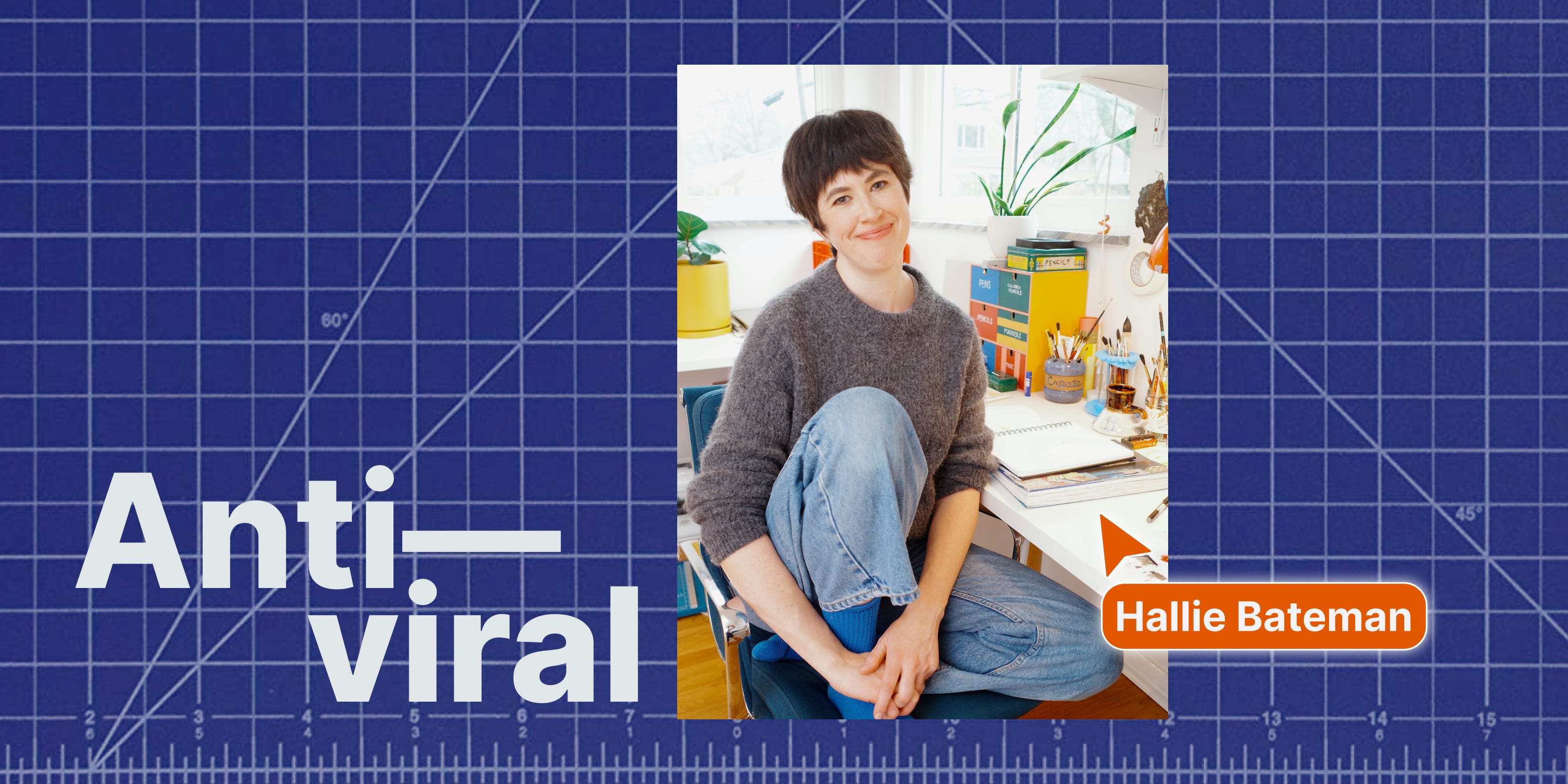
In today’s conversation, Elan Ullendorff speaks to the writer, illustrator, and cartoonist Hallie Bateman, whose work has been published in The New Yorker, The New York Times, and Buzzfeed. Amongst other things, she discusses the emotional rollercoaster of making art on the internet, the rise and fall of Instagram for artists, and what happens when a creative project succeeds as a vision but fails as a business.
You can find a full collection of resources mentioned and highlights from this conversation in this Sublime collection.
What would you say is your relationship with “The Algorithm?”
My first thought is resentment that teeters into begrudging acceptance, similar to my relationship with reality. It just is. There have been times I’ve benefited from the algorithm, and times it’s rendered me nearly invisible. Seeing myself in relation to it can be very frustrating — like banging your head against a wall — because I don’t want to tailor my work to an algorithm.
At times I’ve felt like I’m making work in a vacuum and having identity crises, but it’s also been a reminder to focus on the work and focus on art as communication. 2011–2015 on Instagram felt like a golden period. I was supported at a time when I was a young, fragile artist. Maybe it was the lack of an algorithm. My work got seen, I got a platform, and then around 2017–2018 it plummeted and has kept plummeting. I’m making the same work, I’m the same artist. I’ll post a drawing and twenty people will see it out of 100,000 followers.
I’ve heard you say that when you publish something, you’re frightened by your own desperation for approval. Does that still resonate, and has it dissipated or been heightened by being less visible online?
I don’t remember saying that, but it’s true. This gets complicated quickly. In 2022–2023 I stopped sharing much of my work and turned inward. It felt like silence and invisibility.
More recently I’ve come out of that through Substack: sharing work in a new place, with a new algorithm. It isn’t as simple as “I just have to believe in myself and that’s enough.” I literally made a mirror behind me that says “I believe in you.” I was trying to summon self-belief, but that doesn’t capture communication.
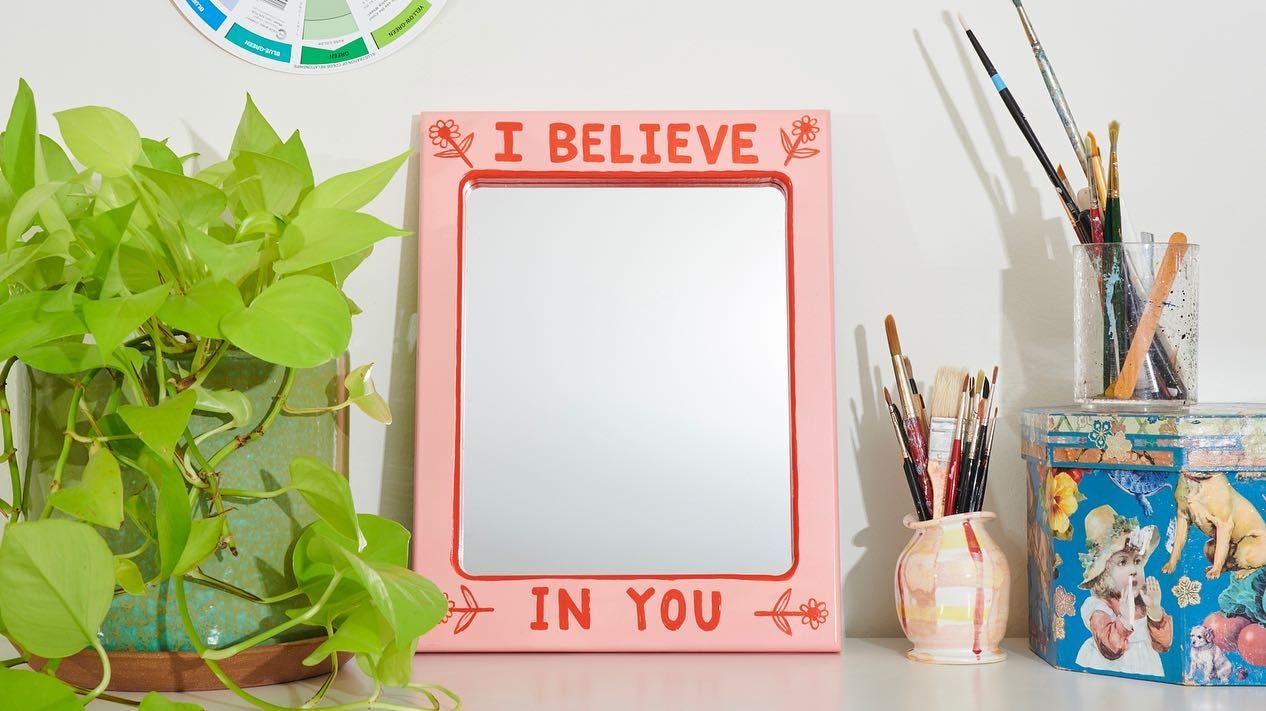
The desperation for approval is the frothy top layer: “I hope people like it.” Beneath that is a deep desire for communication, community, and understanding. If I were the last person on Earth, maybe I’d still make art, but it wouldn’t be the same. There’s an essential ingredient: expressing something and having it be witnessed by others, having people say, “I see that too.”
On the old Instagram, the wheel would get a full rotation: it’s out of me, it has a life, someone tells me what it meant to them or it made them laugh. That’s a huge reason I make art. It isn’t fully done without that.
I want an audience. The idea that it’s only about belief, likes, and approval is one piece of something bigger: wanting my work to be part of a wider conversation. My lesson from Instagram is to hold platforms loosely. If the audience dips, don’t let that stop you. It’s jarring to go from thousands of likes to twenty, deep into your career, but it isn’t personal.
We’ll probably leapfrog platforms forever. I’ll be shocked if Substack doesn’t enshittify. The question is how to protect your work from someone else controlling the applause button. Making work through the ups and downs of algorithms has strengthened my resolve. I turned inward for years; it all lived in sketchbooks. Then I shared again. That’s part of it.
When I emailed you about talking about something meaningful that failed in the marketplace of online attention, you immediately knew you wanted to talk about Halmart. Can you tell me how that project got started?
I believe it was 2021. I’d been running an online shop for years. I used a basic local printer; I did little projects: pet portraits, and I got an ID card printer like a gym uses and printed “artistic licenses,” little licenses to make art. The shop was a repository for ideas, and it started making enough money that I sat up and thought: I’m barely trying and it’s working. I thought what if I tried? It was easy, and I saw that as a problem. I wondered if I had other ideas I’d never realized. So I closed my shop for a year and built a new iteration: Halmart.
It was everything I dreamed, and it was really hard. I engineered physical objects. I made a “now” clock that ticks and every number says “now.” The work was enormous: talking to clock parts people in Canada, and multiplying that by every product. I made pillowcases, the mirror, found a printer for archival-quality prints. I made everything the most beautiful version it could be.
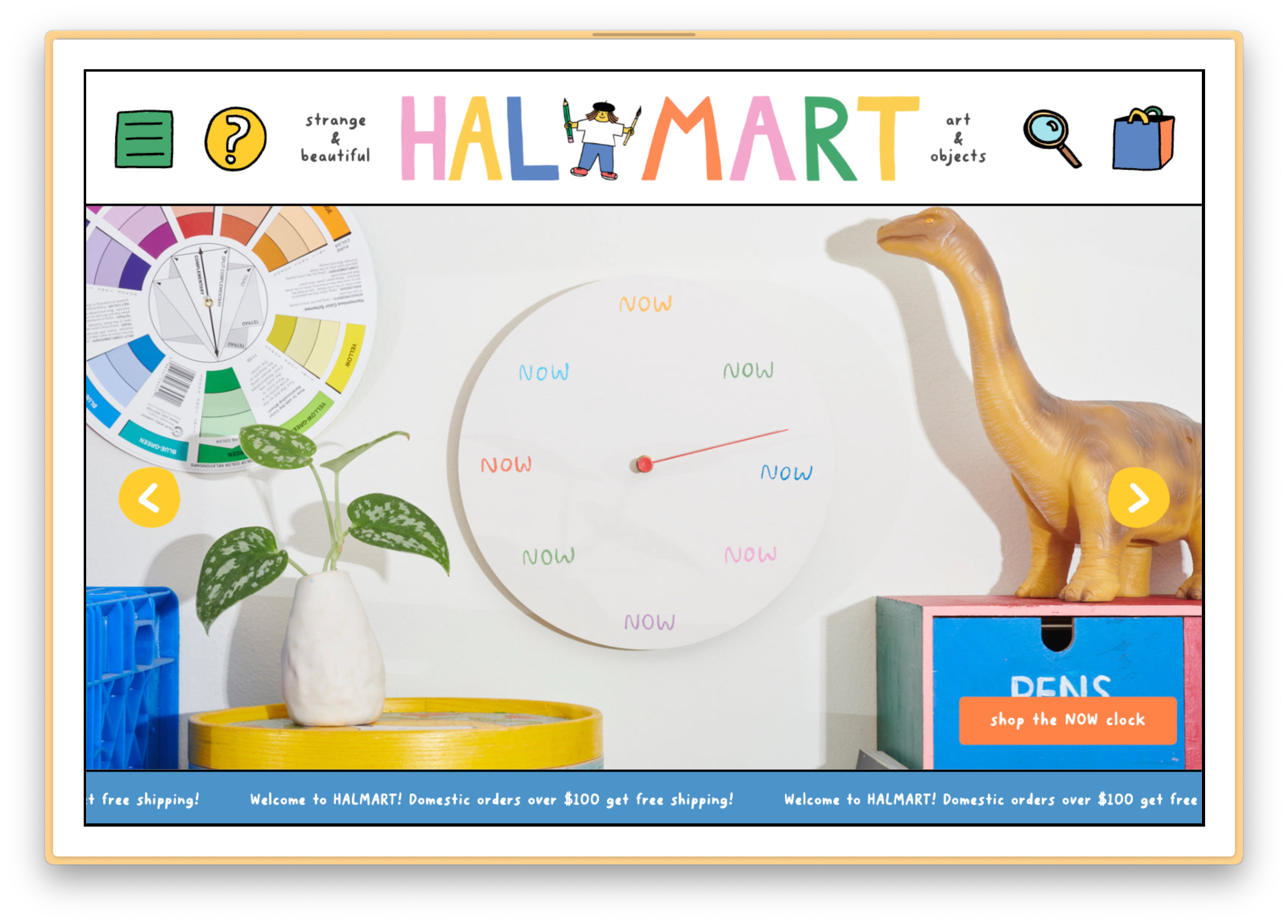
The website was a masterpiece: I worked with my friend Jesse Vaughan. I wrote and co-directed two infomercials, went to prop houses, got friends to act. I can’t describe how much work it was. I didn’t linger on the fact that the shop would launch and then I’d have to run a shop. But it was satisfying to make things real — to turn sketches into objects and share them with the world.
Other than the income, what would the shop succeeding have represented to you?
It was an online representation of myself that was glossy: the best, most colorful, fun, beautifully photographed, silly version of me. I’m amazed by people with tailored online presences. I’ve always been scrappier: my website is ten years old and I haven’t updated it. Things don’t match, I draw in different styles, I don’t have uniformity. The shop was like: “This is Halmart, I am Hallie, look how cute.”
But that isn’t me. The thing I took for granted — my old store where I’d say, “I got a gym ID printer and I’m making cards” — was more me. I’m proud of what I made with Halmart, but it was me wanting to see myself as fully realized.
You told me that when you showed people products in person, they said they’d buy them, but when you launched the shop, most of them didn’t.
I thought two things. First, the boom in 2021… we all had pandemic bonuses. It was a famously spendy time. I didn’t clock that. I thought: I have a lot of potential.
Second, I was enticed by realizing a vision. I clicked into that zone. I made choices like nicer paper, even if it cost more. I wanted to be a fancy artist lady people pay a lot for, because everyone says, “You’re worth it! Charge more!” I still see influencer videos about undercharging.
But I tried the fancy version and it didn’t work. People didn’t want the nicer thing. They wanted the $25 print they can tape to the wall. The artisanal, museum-quality thing satisfied me, but I was trying to value my work in a different way, shepherd it into an era where I’d be more valued.
Then launch happens, and suddenly I’m a girl who runs a shop. Then there’s more product. I realized how constant the promotion is. Constant.
Do these platforms position your work in a way that makes people expect cheap work or cheap prices?
I don’t think it’s necessarily my work, but I do fall into “commercial artist.”
I’ve never been in the fine art world. Even when I make drawings without words, they resonate less. I put original drawings and paintings on my site and thought: why shouldn’t this be $500? Other people do that. But essentially, I’m a commercial artist, and most things are cheap now. If someone can go to Society6 and get a $15 print from an amazing artist, why would they buy mine? They don’t care about paper or museum quality.
Expectations sometimes get set for you. You can try to steer yourself into a different category. I was exploring: can I control this, can I declare value? Someone thinks something looks like a child drew it; someone else thinks it’s an original David Shrigley worth $15,000. It’s all made up, so why couldn’t I do that?
When I priced my shop, I tried to resist undervaluing my work. I asked: if I walked into a fancy gallery and saw this, what would I pay? That painting behind me is by Esther Pearl Watson: amazing illustrator, zine-world cartoonist, makes books. She’s in galleries now. Why not me? I was pushing myself in that direction and learning lessons.
Are you saying putting your work on Instagram makes people not see you as a fine artist, or is it about how Instagram’s algorithm sees you compared to fine artists?
My impression from fine artists I follow is consistency and restraint. It doesn’t seem confessional. It isn’t a place where you post videos talking about personal stuff. I’ve talked about personal stuff.
I remember talking to a friend who went to art school for painting. She said fine art is about the art but also a lot of branding. One teacher told students to pick a haircut and stick with it so you’re recognizable.
My art doesn’t look the same; I change my hair. When I created Halmart and tried to contain myself in a beautiful box, I was valuing traits I don’t have. Looking back, what I want to take forward is that ease isn’t a problem. When you’re gifted at something, it feels easy and you take it for granted. You start thinking struggle indicates quality.

Now I try to notice where the water flows — where energy naturally pours. When I created Halmart and told myself “try so hard,” everything was a struggle. You tell yourself you’re glad you did it, because otherwise you’d explode.
What happened to the shop?
I decided to close it in summer 2023, right around the time I got pregnant with my twins. I could have kept running it. I ran it for around six months, and I felt completely run down by posting: buy this, link to this. That felt awful, and it didn’t feel like communication. I felt like I was selling to my audience. I wanted it to be worth it, wanted it to succeed, but I didn’t want to do the work to make it succeed.
How did it feel to shut it down?
Such a relief. I’m happy about how quickly I stepped aside. As soon as it clicked that I didn’t want to be a shop proprietor — that it’s a full-time job suited for a different type of artist — I was done. I felt bad because I looped in people who helped me but I had to say: I was wrong about my dream. I didn’t want it.
That’s why it isn’t simple to call it a failure. Did it sell amazingly? No. Did I also not want to do it? Yes. I like the making part. I want that to be most of my work. I didn’t fully understand that when you have a shop, your main work is selling; the rest becomes frustrating gridlock.
If there was a failure, maybe it was in the fact that you created an idea of yourself that you didn’t want to inhabit for longer than six months.
Yeah. I’m good at making art. I’m okay at sharing it and sometimes selling it. With books, the book finds its audience if there’s one there. That tells you something. The book I’ve made that’s most successful is What to Do When I’m Gone with my mom in 2018. It has had a long life. I know because I hear from people: “I give this book to everyone.” I made the work, and it just reaches people. I’m not posting every day on Instagram.
Moving forward, I want to make work that matters to me and tell stories that matter to me. The work is at my desk, giving myself space to write and draw, having conversations and sketching. That is the work.
One of the things available in Halmart was a print of your “It’s a Miracle We Ever Met” illustration. Can you tell the story of the genesis of that?
When I’ve talked about it, sometimes I say it’s about everyone I’ve ever loved. I don’t have one memory associated with it, but I remember being with my little brother Nick on his birthday one year, sitting by the ocean, thinking: I can’t believe how crazy it is that we’re from the same family that out of everything, out of a bajillion sperms and eggs, it’s the two of us, and we’re hanging out. I don’t know where the image came from. Sometimes stuff drops into your hand or sketchbook. I didn’t set out to make it; it appeared.
Sometimes I’ll make a new friend and I’ll give it to them. It does feel astonishing to connect with anyone in this world. The rarity can be taken for granted, and it felt nice to visualize that.
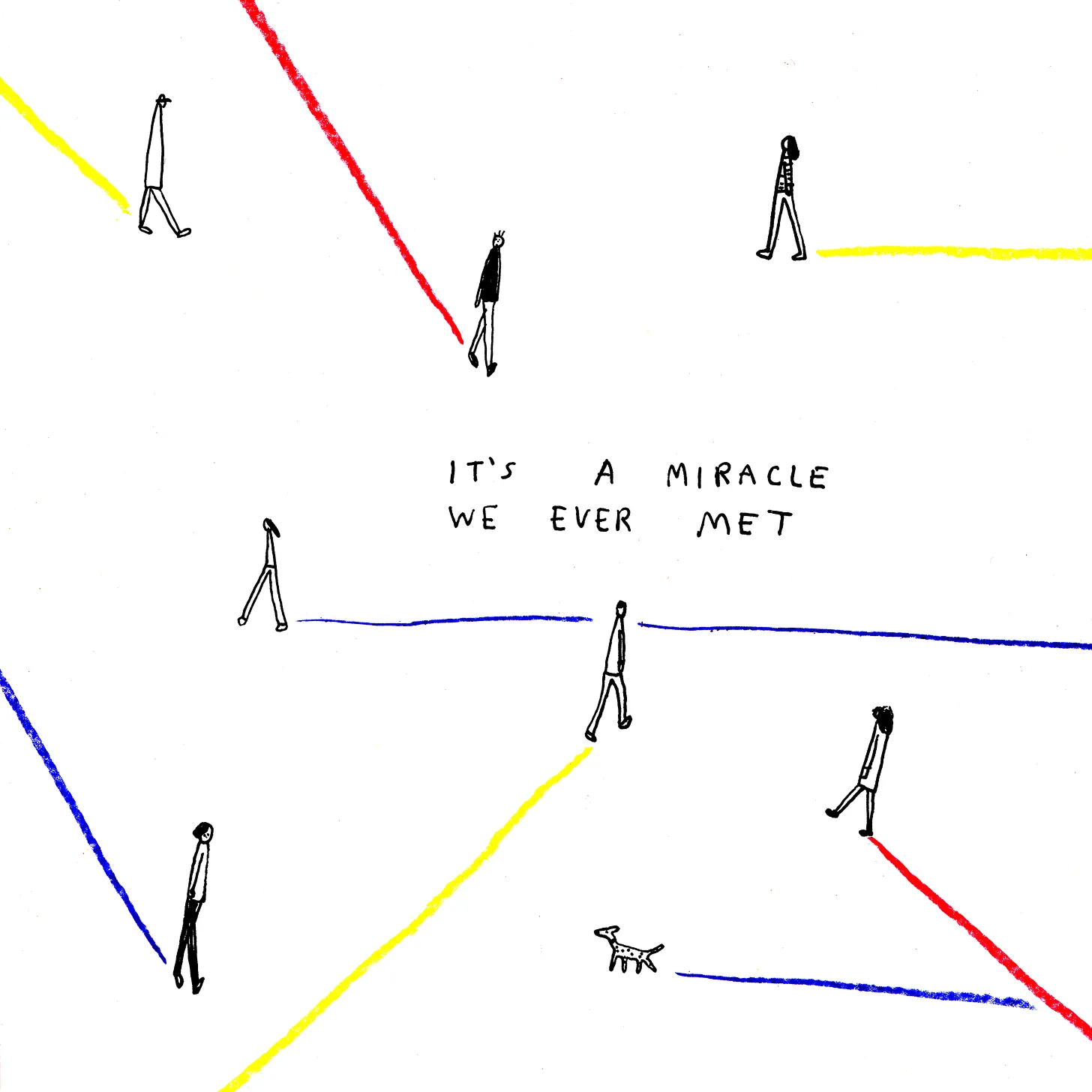
I’ve seen many versions of the illustration in the wild: low-resolution screenshots of screenshots. Some that are copycats, the same illustration with different captions. Knockoff illustration with the same caption. People tattooing it on themselves. How does it feel to see your work become a meme?
I don’t think anyone’s asked me in this way. It’s interesting because I just described it as something that showed up, and it’s cool to reflect on that.
For the first few years, as it started to run away from me, I was reactive. I remember around 2019, Deepak Chopra’s Instagram posted it without credit. I got upset. I’d link to them, people would pile on and shame them. I was trying to hold on to it. I’m not saying “everyone go steal it,” but there’s a point where someone will DM me saying something’s a rip-off, and I’ll say: whatever. It was so long ago; I’m making new work now.
It’s crazy that something I made resonated so much that someone got it tattooed all over their body without having any idea that I made it. Would I love credit? Sure. But spending my current moments guard-dogging old work is not the best use of my time. It’s nice when someone can connect and find my other work. My job is to focus on what I’m making. I’ve done my time pearl-clutching that the internet is a garbage heap. I’ll just make some new garbage.


I’m obsessed with the idea of this illustration as a commentary on itself: it’s a miracle that it finds anyone, given the sheer magnitude of all that exists online. There are two ways to greet that miracle: with awe at the attention and labor that went into it, or by shrugging it off as unexplainable and contextless.
When I said earlier that one lesson of Halmart is holding things lightly, letting things have ease, paying attention to resistance… have you heard of Bread and Puppet? It’s a Vermont-based activist puppet theater. I learned about it recently and saw them perform in Cincinnati. It was in a big church; tons of families; donation-based. They performed with huge puppets, a dragon filling the room. We got a $2 print of the Cheap Art Manifesto:
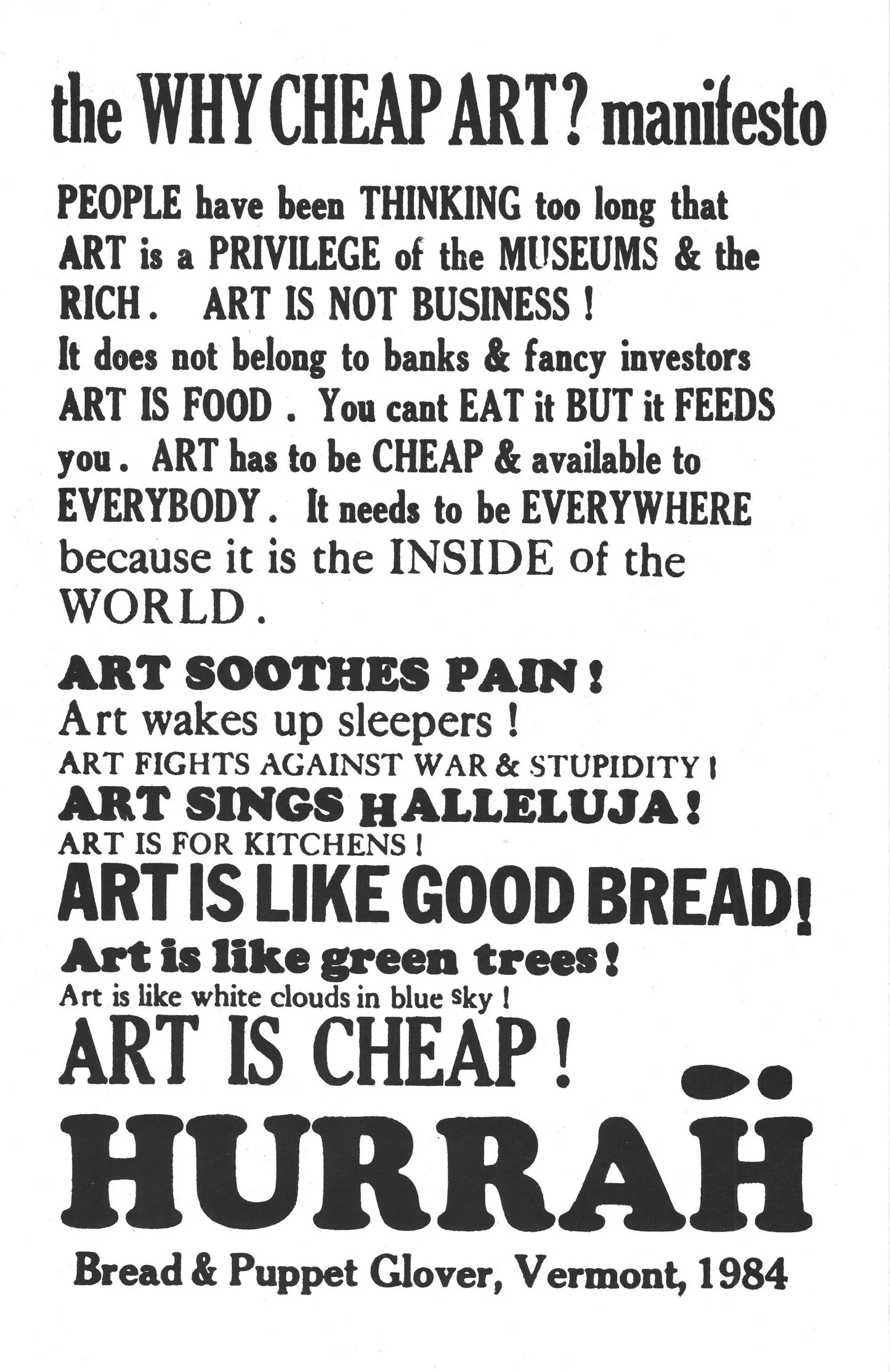
When I’m sitting there thinking, am I fancy enough, am I worth this or that, I’m participating in “art as business.” Any time I’ve slipped deep into the business side, it’s been miserable. That said, it’s a privilege to not be hustling for money.
But I like the Bread and Puppet ethos. That’s why I don’t charge for my Substack. I feel honored that anyone spends time with my work. What I value most right now isn’t money — it’s communication, community, shared understanding. After years of being contained in my sketchbooks because Instagram was so inhospitable, I crave communication. Even you writing to have this conversation is an example: I want to share reality together. I crave that more than anything right now.
These days, you can support Hallie’s work by subscribing to her free weekly newsletter HALMAIL, by following her on Instagram, and buying her books or prints. Also, she’s teaching a micro-memoir retreat in Spain this fall! And there are still a few spots available.
You can follow more of Elan Ullendorff’s work by subscribing to Escape the Algorithm.
 | A guest post by
|
i love the emotionally intelligence & intimacy of this interview, thanks!
Great interview! Thoughtful and relatable, and refreshing to really feel the calm clarity and direction that Hallie has about her art.